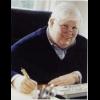
The Perry Mason radio show seems to receive little attention even though it was a unique daytime show and ran successfully for years. Even among mystery fans and devotees of Gardner, it is given short shrift compared to the TV series.
Perhaps due to a lack of available episodes or the perception that it was too soapy. Not sure if that was the case.
Each case/storyline seemed to last many months from what I can gather.
OGDENSBURG JOURNAL, WEDNESDAY, JULY 26, 1950
Erle Stanley Gardner Talks About Radio, Perry Mason And The Wheels Of Justice
The world's best selling mystery writer talks like a social philosopher — at least on the banks of the St. Lawrence.
YESTERDAY, sitting outside Harry Hoff's camp near Merry's Point, Erie Stanley Gardner didn't say two words about the 12,000,000 words of mystery fiction he has written in the past 17 years. Instead, he talked about radio justice, parole systems, and soap.
Gardner is here with 14 friends not to write books but to discuss the daily radio show involving his famous fictional lawyer-detective Perry Mason. . This explains Gardner's interest in radio and soap since the Perry Mason show has been running successfully for seven years under the sponsorship of the Proctor and Gamble Co.
GARDNER, is somewhat impatient with critics of radio's "daytime continuity programs" — i.e. "soap operas." He says the soap opera has raised the intellectual level of America in the past 10 to 15 years. And he insists the Perry Mason type of entertainment gives a pretty honest interpretation of human emotions.
To prove his point, Gardner cites the case of a witness who testified 25 years ago that a Michigan man was a murderer. Gardner began investigating the case this year and got the witness to admit he was not sure of the man's identity. He even admitted the police had roughed him up to make him testify. Yesterday Gardner played. a record of the man's statement. In it, be said a radio mystery show started him thinking about his testimony and how he had sent a man to prison for 25 years. " I got to thinking about it and it just didn't seem right/' he declared.
'THAT'S WHAT radio can do," Gardner remarked as he switched off the record. Gardner's interest in the Michigan case is only one of many instances in which he has helped free innocent men from prison. He and three other criminologists work as an investigating board for a national magazine. The magazine conducts a "court of last resort" which Gardner, insists is simply "the people." Through the "court of last resort" the magazine seeks to have state authorities review cases where there is doubt about a prisoner's guilt.
Gardner says the court has saved two men from execution and has aided many others to freedom'. Gardner, who was a California lawyer years before he started writing whodunits, is greatly concerned with the problem of justice. Last year he and Dr. Lemoyne Snyder, a world-famous, criminologist, sailed to Europe and studied crime detection methods in Scotland, England, 3Tran.ce and Italy. He has also taken part in crime seminars at Harvard University and has made an intensive study of several cases.
THROUGH HIS association with courts and police methods Gardner has come to appreciate the problems of parole boards. "The newspapers necessarily make a play of the cases in which a parolee has gone wrong," Gardner points out. "but it doesn't give the whole picture and it doesn't show the true problems of parole." "What are you going to do with a man who has served 10 years for forgery?" Gardner asks. "If you turn him loose with a prison suit of clothes and $10 in his pocket, what do you think, his chances are?"
THE MAN WHO have a tough time finding a job with only a 10-year prison record for a reference, Gardner points out. 'What's the solution? Why you let him out a couple of years early for good behavior and fry to help him along," Gardner declares. "Some of them go wrong, but in most cases it works." "We've got a long way to go in our system of justice," the ex lawyer concludes. The Perry Mason creator says he likes to keep the principles of justice foremost in Mason's radio show, and that is particularly the reason for the annual conference on the St. Lawrence.
GARDNER DOES NOT write the radio show. Instead, Irving Vendig, one of radio's top script writers, does the job with a little technical advice on legal wrinkles from Gardner. Vendig, who is also the author of radio's Judy and Jane show, is proud to point out with Gardner that the Perry Mason show is the only successful daytime mystery program. A few others have struggled along for a time, but none can equal the thriving 5-day-a-week, 7-year pace of Perry Mason. Gardner and his friends attribute some of this success to their informal conferences every year. Two years ago they met in California, but for the last two years they have met at Harry Hoff's camp on the St. Lawrence. The conferences include, beside Gardner, Vendig, and Hoff, the producer: William Ramsey, director of radio and television for Proctor and Gamble; Al Morrison, P&G program supervisor; Walter Craig, vice president in charge of radio and television for¥ the Bentpn and Bowles advertising agency of New York; and .Gardner's two secretaries, Lili MacLean arid Jean Bethel .
ALSO ALONG AS CRITICS .and vacationers are Mrs. Craig, Mrs. Hoff, Mrs. Ramsey and Bill Ramsey Jr., Mrs. Vendig and Laurie Ann Vendig. The clan has gathered from all corners of the U. S. California, Florida, Ohio, New Jersey, and New York — and they seem to be enjoying life on the river immensely. As Gardner himself puts it: "It is a salubrious climate devoid of gnats, flies, mosquitoes, and other disturbing influences." Gardner and his party plan to remain in the salubrious North Country until Sunday.
By
Paul Raven ·
Join the conversation
You can post now and register later. If you have an account, sign in now to post with your account.