





Jdee43
Member
-
Joined
-
Last visited
Everything posted by Jdee43
-
-
-
-
-
Seriously, if the producers wanted to bring Larry Haines or Forrest Compton or someone like that to the show long term, they should have had them be a recast Mitchell Dru. Then they instantly would have had Ada, Rachel, and Aunt Liz to talk to. Since Dru was a lawyer, they could also have had him hang around Cass. Such a recast could have fulfilled the older, wiser male character role that the show needed, especially in the 80s and then especially after Mac died. Also having him around would have paid tribute to Irna Phillips, who loved the character.
-
Going back to a pre 1975 character you would have liked brought back, how about Mitchell Dru? They could have revealed that he was really a lothario, and that he was also Cass Winthrop's true biological father 😂 And of course, being the only old guy in town, they'd finally have to pair him with Ada 😅
-
An annoying part of this show is the chronic character assassination of Matt Powers. Especially annoying are those things that happen out of the blue, with no build up, that you know the real Matt wouldn't do. Another one happens on the episode labeled Dec. 18, 1968, where Matt snaps at Mike after Mike tells him he's doing poorly in medical school. I guess I could take Matt's reaction. What I couldn't take was him allowing newbie Nancy Bennett to dress him down for it. The real Matt would have walked out on Nancy at the start of any such conversation or fired her after having it. Such poor writing, at the expense of Matt, to prop up a new character and try to set up a Nancy / Mike love story. Maybe it was a Rick Edelstein writing day and not Rita Larkin.
-
I've been watching The Doctors from 1968. After I watch each episode, I read the synopsis on the AW home page for the AW episode that aired that day after The Doctors. AW was such a different show in 1968. If there was a theme, I guess it was maybe couples fighting to be together? There was Missy and Bill, trying to overcome her shady past and his mother Liz. There was Lahoma and Sam, trying to overcome her insecurities and his lingering feelings for Lee, John's daughter. Sam and Lee were never one to have that one conversation to clear the air; instead there was tension whenever they saw each other. I guess the most interesting character is Rachel. By late 1968, she's married to Russ. She doesn't want to carry his child. She doesn't want to find their own home; instead she's fine living with his parents. She's flirting with Steve. She's ignoring her mother Ada, seeing Ada as beneath her. AW had such a strong female cast in 1968: Judith Bancroft (Lenore), Audra Lindley (Liz), Carol Roux (Missy), Barbara Rodell (Lee), Ann Wedgeworth (Lahoma), Beverly Penberthy (Pat), Jacqueline Courtney (Alice), Constance Ford (Ada), Robin Strasser (Rachel), Virginia Dwyer (Mary). Wow!
-
Certain characters drag a bit, especially in the summer, but never Nick and Althea; they are great throughout 1968! And the show rebounds; Oct/Nov/Dec 68 are just as good as Jan/Feb/Mar 68!
-
-
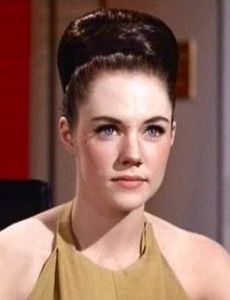
Lezlie Dalton looked amazing on Star Trek! I had no idea she was on Guiding Light! Only after imdb-ing her did I learn she was on from 1977-1981. I'm happy to see that some of her time on the show is online, especially from 1979 and 1980. Her vibe on GL was so different than on Star Trek; on GL she's much more soft spoken and less aggressive. Interesting too to see a young Cindy Pickett on these shows with her; I'm familiar with Cindy from the later years of St. Elsewhere. A shame how their story and characters were never really mentioned on GL in its later years!

-
There was an old article in one of the soap mags from the late 60s supposedly written by C.C. Courtney, Jody Lee on the show, where he interviews Lydia Bruce on her first days on The Doctors. There Bruce says that she was initially only a temporary replacement for 8 weeks, that Bethel would be back after filming the movie Molly McGuires. But then the producers told her that Bethel wasn't coming back. I assume that happened early in Lydia's run, maybe her first or second week on the show. They literally changed the story a few weeks into her run to try and make her version of the character work; I assume they wouldn't have done that for an 8 week replacement. Wiyh Lydia already playing Maggie, I guess they just went with it. If you look at Bethel's last episode though, May 10, 1968, there is a sense of finality in her final scenes, like they were subtly giving her version of the character a send-off, giving her Maggie and Matt a happy ending, for her last day. I just think in a perfect world, they should have left Bethel as Maggie, allowing her to pop in and out whenever she wanted, and bring in Lydia as a new character. Imagine a Bethel Leslie/ James Pritchett/ Lydia Bruce triangle playing out in 1971 or so.
-
1968 was a great year for the show creatively. Still, there were negatives. Number one was recasting the character of Maggie. The transition from Bethel Leslie to Lydia Bruce was rough, and I think damaging to the show in the long run. Among other things, the show sacrificed a bit of Matt Powers's moral integrity in order to make Lydia Bruce's Maggie more sympathetic. For example, out of the blue, they had Matt kissing another woman and basically thinking nothing of it. In hindsight, I think it would have been best to write Bethel Leslie's Maggie off and bring Lydia Bruce on as an entirely new character. Lydia's Maggie is nothing like Bethel's anway; she is playing a new character in everything but name. Lydia would have been spared Maggie's history. The audience would have been spared Matt's character assassination. Lydia and James Pritchett have great chemistry; the audience would have enjoyed seeing them build a relationship on-screen from the very beginning, instead of jumping into one that was already established. Building a new relationship could have driven story for them for years. Instead, by the end of 68, with Lydia settled in as Maggie, there seemed to be no story for them, no where to really go. And bringing Lydia on as someone new would have left the door open for Bethel to come back, if only for guest appearances. There was a lot of wasted opportunity and poor choices in bringing Lydia to the show.
-
-
Allen M. Potter was AW's last good executive producer. Ironically, he was its first ep in 1964! He was also executive producer on The Doctors from 1967-1973 and Guiding Light from 1976-1982, strong eras on both shows. AW from 1983 through 1984, when he rejoined the show, was really good! It's too bad he retired in 1985 and didn't stick around a few more years. If he had, AW would definitely have been in a better place in the late 80s!
-
From the article, I thought it was silly for Rauch to make a point of saying that "there will be 'no archetypical villain' modeled after J.R." So they're doing Dallas, but taking out the most fun part? Were they aware of what made Dallas work? The ABC network exec at the end of the article had Texas pegged right, all scenery but no interesting plot. And after a few weeks, there wasn't even scenery. Texas ended up being shot mostly in a studio in Brooklyn. Rauch's original idea of a soap set in the south, with a woman returning home after the Civil War, sounded much more interesting. I guess it would have been too controversial to modernize though. A woman returning to a southern city after all the upheavals of the 1960s I doubt would have gotten on the air. Interesting that NBC would allow Rauch to executive produce the new show, after failing badly with another AW spin-off a few years earlier, Lovers and Friends, which became For Richer, For Poorer. AW itself was not in very good creative shape either by 1980. But no doubt they were looking at the bottom line, $$$. I thought it was really interesting that AW was bringing in more profits per episode than the Tonight Show, $28,000 worth! Both were 90 minute shows in 1979-1980.
-
For Another World, killing off Bill Matthews off screen in 1970, to free up his wife Missy for adventures on the AW spin-off Somerset. Missy wasn't even on Somerset that long; both characters were lost forever to Another World; and Aunt Liz had her son taken away, weakening her character, giving her less to do. Killing off Bill started the dismantling of the Matthews family. And another early dumb one for AW was killing off John Randolph's daughter Lee in 1969. Both the characters of Bill and Lee had been on since 1964, and had lots of potential left.
-
How is Days of our Lives even still on, producing new episodes? Are there really a lot of people out there watching it, a new streamed show every weekday? Do they ever pick up brand new viewers, who've never seen it before?
-
https://www.washingtonpost.com/archive/lifestyle/1980/08/03/the-soaps/168439d7-c212-4a7f-8151-d2408ff455fc/ The Soaps -- 'Texas': A New Soap Opera That Wants To Be The 'Dallas' of Daytime By Joel Swerdlow August 2, 1980 THE WORLD will have to wait for the fall to discover who shot J.R. Ewing. But starting this week, viewers have another way to get deep in the turbulent heart of Texas. Tomorrow afternoon at 3, "Texas," a new soap opera set in Houston, premieres on NBC. "It'll be the 'Dallas' of daytime," brags NBC programming chief Brandon Tartikoff. "If it sounds like a daytime version of 'Dallas'," says Daytime TV magazine, "Well, imitation is the sincerest form of flattery." And there's more to come: NBC's afternoon round-up is only the beginning of what looks like a network trail drive into the Lone Star State: Big-spending Texas couple Bo and Asa Buchanan were created for ABC's "One Life to Live" last January; more and more Texan characters appear on prime-time programs; and ABC is preparing the series called "Oil!" as a likely mid-season replacement for the fall. Although "Texas" Executive Producer Paul Rauch denies the "Dallas" connection, his heart is deep in Dixie. "Back in 1978 I worked with two writers, one from Houston and the other from Shreveport on developing a daytime show called 'Reunion' about a girl who spent the Civil War in England and then returned home. It didn't get on the air, but last summer NBC asked if we would develop a contemporary show." Many of the "Texas" characters are still undefined, but Rauch emphasizes that there will be "no archetypical villain" modeled after J.R. However, there will be "lust, sentiment and men and women bigger than life thrust into each other's lives," says Jason Bonderoff, editor of Daylight TV. The new soap was created in one of the most elaborate spin-off plans in TV history. Last May, fans of NBC's "Another World" (for which Rauch is also executive director) began to see new characters. Disillusioned by love, young Dennis Carrington moved from midwestern Bay City to Houston. His nasty mother, Iris, accompanied by her cranky maid Vivian, followed him. Iris loves to manipulate Dennis, her only son. And besides, she had become friendly with Reena Cooke, a former Texas belle married to Dr. Kevin Cooke. Reena got Kevin to move to Houston, and, of course, invited Iris. Last June, they jumped into a private jet, and since then half of "Another World" has transpired in Houston. The best is yet to come: In her youth, Iris had a love affair with Alex Wheeler, now head of Houston-based World Oil (and more powerful than the entire Ewing family put together). Alex never married because for a quarter century he's nursed a love for Iris. The two meet again in Houston and flames flicker, but then Iris finds out about Vicki, with whom Alex has been having an affair for 15 years. In the last episode of "Another World," broadcast last Friday, Iris boarded a plan and flew away from Houston and Alex forever. But Alex, like J.R. before him, likes to call the shots. Tomorrow, in the first "Texas" episode, he has Iris' plane called back, hustles her into a chauffeured limousine, and holds her captive on his luxurious yacht. Viewers fearing for the safety and virtue of Iris must stay tuned. Despite its close clone-like similarity to super-hit "Dallas," the new soap faces a tough challenge. "Another World" has attempted two previous spinoffs -- "Somerset" and "Lovers & Friends" -- both of which failed. "Lovers and Friends" eventually became "For Richer, For Poorer," which disappeared several years ago, and was NBC's last attempt at innovation in the field. Nonetheless, conditions may be favorable for a new daytime drama. Nielsen figures show a slight increase in the audience for soaps, even though the percentage of women in the work force is also increasing. Experts believe the explanation lies in the new youth-oriented plots and sexuality injected into the shows, especially by ABC. "They've been the hottest network for over 10 years," says a broadcast executive. "They do the most and they set the trends." One reason for ABC's lead is that Procter & Gamble -- virtually the only soap company still in the soap-opera business -- owns only one of four ABC shows. "P&G ownership makes a big difference," says Bonderoff. "They keep a close watch on their shows, and they're very conservative." A P&G "memorandum on broadcast policies," quoted by media historian Erik Barnouw, in "The Sponsors" says: "There will be no material that may give offense to any commercial organization of any sort." But NBC daytime programming chief Linda Line says Texas would be a breakthrough program for P&G. "They are sensitive to trends in public taste." Line claims to feel under little constraint. "I would do anything that would work as a good story," she says. The stakes are high because soaps generate extraordinary profits. Internal NBC documents obtained by Variety recently reveal that for 11 months spanning 1979 and 1980, the 90-minute "Another World" (which finished third in its time-slot) took in $230,000 per broadcast in net revenues, cost $71,000 per episode, and consequently earned a profit of $159,000 per broadcast. By comparison, "The Tonight Show" earned net revenues of $190,000 and a $131,000 profit per broadcast. With such figures, it's not surprising that NBC President Fred Silverman showed up at a cowboy-style barbecue at Rockefeller Center last week to celebrate the start of "Texas." Silverman served as the CBS daytime programmer from 1962 to 1970. "He had a poor record," says Bonderoff. "He decided that soaps weren't viable and replaced them with game shows" But "Fred is very close to this area and feels very excited about "Texas'," says NBC's Line. "He and I decided together to put it on the air." NBC's flashy, provocative promo ads for the new show have been running throughout the prime-time and daytime schedules. "It's the most ambitious campaign ever launched for the debut of a daytime program," says Line. Ultimately, NBC need not worry about losing money. A recent Federal Communications Commission staff report -- based on examination of available network records spanning several decades -- concludes that " a daytime program series usually returns a profit from initial network exhibition, even if it is canceled after a brief run." But NBC is after more than a profit. "We hope to set the standard for quality programming," says Line. "We want to say that characters can no longer sit around the coffee table and discuss their neighbors. We'll have more sophisticated plot devices and an upgraded production that will look like prime time." Executive producer Rauch claims "Texas" "will revolutionize daytime television." He cites the extensive exterior shooting (soaps have been going outdoors more often since about 1978), the use of cinematic filters to achieve a softer look and brighter colors, and the full development of an identifiable city. The other networks are sitting back in the saddle and waiting to see what happens before they, too, ride into Texas. "It's an interesting experiment. I'm glad to see it," says Jeanne Renick, CBS' east coast director for daytime programs. CBS, according to Renick, has no present plans for Texas-style spin-offs. ABC's Jacqueline Smith says her network is working on "General Hospital," it will remain in the East. She is reserving judgement on "Texas": "All the scenery in the world won't help a show that doesn't have the necessary plot interest. Scenery is still scenery," she says.
-
-
So it wasn't the writers who decided to break up Scott and Liesl, but the actors? As in there was some BTS drama?
-
I'm watching the December 1968 episodes. There's a blooper in the episode labeled Dec 17, 1968 at 4:14. Pamela Toll's Liz, locked in a room against her will, desperately tries the door again for what seems like the 100th time. Only this time when she pulls on it, the door actually opens!! Toll quickly closes it and leans against an adjacent wall, crying! I guess she knows she's supposed to be stuck in that room for some time! Too bad no one told the door that 🤣
-
-
-
