





Contessa Donatella
Banned - Not Active
-
Joined
-
Last visited
Everything posted by Contessa Donatella
-
 He's now been voted the most stubborn EP. I am unaware of there ever being a competition but he's won hands down. And, ME said the show is all-in on this & Soap Central said that he said he was all-in. I believe there are 7 fans which Frank can swing to like FIZZLE. The rest? Not a chance.
 -
Please drop that shoe! What show was it?
-
-
Great post! 👏👏👏
-
So 2 YouTube clips showed up in my memories for today, Daytime Emmys 1982, GL for both Writing & Show: Marland win/Writing thanked Agnes Nixon, classy, Bob Short/Ed Trach of P&G, so great for so long, and with other CBS folks he thanked Brian Frons & I almost fell on the floor! Boy, the time's they been a'changing! Patrick Mulcahey is standing behind Marland. When the EP was up for winning Best Show he said: we won 2 yrs ago & they told us we had no time & now they say we have no time so Doug Marland said it all, when we get up here we are driven to it & we are a family & we are #1. The GL Table was going wild!
-
So, DAYS here, that was Steve & Kayla?
-
-
-
I don't recall Li being completely fine. Of course, we also haven't seen him in ages. Last time he wasn't in crisis but he wasn't a happy camper either. Trying to remember, wasn't he fooling around with Melinda? I wish I understood what the show is doing having Marlena & Kate on every single day. I like it fine but it's weird. I was just glad Stephanie finally said his name. When he said he loved her as much now as he did the day he left for the Post Ofc, I wondered if we were meant to think, Shades of Neil Curtis and Don Craig! I loved Nicole's line, "I'm not getting married on Halloween." But, I pretty much loved all her dialog, holding EJ's feet to the flames. Everett, running into Stefan & Gabi, awkward.
-
I don't think anyone knows any details about what DIGEST is going to be like now. Will they have weekly deadlines? Will they do feature stories? Will the 4 print issues be special editions? Will they continue with the podcast? With Best & Worst? With Thumbs?
-
I posted just last week about the 80s, somewhere, either on my forum or on Twitter. A bit different. I was an adult in the 80s. Nancy & Ron inhabited the White House & never once uttered the word AIDS. I can't tell you how many friends of mine died. Huge changes in phones, TV, cable. Being online got to be a thing. DOS 3.0. My first PC. Dial-up at 14.4! Soaps & music, of course, were phenomenal. If I recall correctly that's when we went from long distance charges being horrendous to much more reasonable fees. Ronnie was wrong about trickle down but right about telecommunications. But because of AIDS & politics I don't have as rosy a nostalgia for it as some do.
-
I don't understand. JFP was a Producer not a Writer. Are you saying she tried to usurp HW's prerogatives?
-
I really laughed at Joss's petty, poor pitiful she perspective! I do not dislike her as many do, but I can make fun of her & her very human foibles. To me she is very real, relatable & definitely messy in the way many soap characters are. Recently I even appreciated her & Dex & their care & concern for Ava. Also I love the way Joss is a good big sister to the two littles, Avery & Donna. The water gun fight was perfect! And speaking of Ava, it is killing me that she still thinks she killed Nik! All of these people know he is alive & well, but nope, noone has told Ava! She is going to be so pissed! Of Sonny's children, of course, I adore my namesake, Donna. But it is really Kristina & Dante that are really the very best of his kids. And they both, and each, take him just as he is. They accept him & love him. And, they don't honestly have some huge affection for Nina, but they don't need to. It is enough that she makes their Dad happy.
-
No idea where to put this, so I'll put it here. IS THERE A "STAR" SYSTEM IN DAYTIME TV? SPECIAL REPORT By MICHAEL LOGAN Long, long ago in a Hollywood few of us would remember the star stystem reigned. Not only did the Stanwycks and the Crawfords and the Gables grab the juiciest parts and the plumpest paychecks, they were also pampered with a glorious, unending shower of sweet status symbols. They drove better cars, wore better clothes and got top billing. They had high exposure, were treated better and they always got the better ringside table at The Coconut Grove. Maybe they don't make 'em like they used to (either the movies or the stars), but one thing hasn't changed. Hollywood is still desperately, hopelessly in love with the art of one-upmanship. The mega-watt stars in today's galaxy of films and primetime TV may be fewer in number and less luminous than their counterparts of yesteryear--but they are, by no means, gone with the wind. But what of daytime TV, that sudsy sector where a show can boast a cast of thirty-five or forty players, each anxiously seeking a share of the limelight? In a medium where most viewers would be hard-pressed to come up with the real life names of their favorite performers, could an honest-to-goodness, certifiable star system exist? "Any actor who thinks he is the star of a soap opera is deluding himself," insists DAYS OF OUR LIVES veteran Macdonald Carey (Tom Horton). "It just doesn't work that way." "Nobody pulls a star game around here," claims A Martinez, who plays Cruz Castillo on SANTA BARBARA. "The audience is the star system," says DAYS's Kristian Alfonso (Hope Brady). "That's who makes or breaks us." There are those who might scoff at Alfonso's modesty for she is, after all, the epitome of a soap opera star. She is extraordinarily beautiful (witness her recent cover of Redbook--unprecedented for a daytime actress), she has a phenomenal fan following and, for the third straight year, enjoys a prominent storyline on her series. In short, she is a prime candidate for the star system. But the gal who plays Hope Brady, to the delight of millions, just won't buy it. "Actors forget that they're just a piece of the show," she insists. Others disagree, believing that there definitely are certain daytime stars who rise above the rest--and are rewarded for it. Preferring anonymity, a Los Angeles press agent who specializes in soap actors says, "Many will deny it but a star system does exist. Just look at the cast of any show. Some actors will pull big money and others won't. They'll also be on the receiving end of lots of perks, very fancy leather couches and chairs, that type of thing. Within the casts, they certainly feel it. I don't think they're thrilled with it, but they cetainly feel it. It's not exactly what Hollywood had in the '30s and '40s though. Perhaps a better way to describe it--and this is a little pessimistic--is a pecking order. When I first got on (GENERAL HOSPITAL) two years ago, I certainly thought I saw it with Emma Samms (Holly Scorpio)," reveals Shelley Taylor Morgan (Lorena Sharpe). "Scuttlebutt had it that she was just the darling of ABC. And look at Susan Lucci (Erica Kane) on ALL MY CHILDREN. The network seems to promote her a lot, too." Is the key, then, a big publicity push from the studio, the network or a soap's producer? Not according to CAPITOL's Catherine Hickland (Julie McCandless). "You are in an ensemble company," she says "and you are absolutely responsible for fending for yourself. As far as the network pushing a person, the only time that will happen is when your storyline is hot and they're publicizing their show. They're certainly not going to spend money publicizing you!" Shelly Taylor Morgan agrees. "Business people do what they have to do to get their work done. If it's gong to benefit them to make nice over you, they're going to make nice over you. If it's not going to do them any good. You don't exist." Certainly such prime time real estate as Joan Collins, Linda Evans, Larry Hagman and Victoria Principal have been well treated--and well ballyhooed--by their respective networks, indicating that the broadcasting companies can push for stars. But why don't they do likewise for daytime heavyweights? One network press agent refusing to be named, states flatly, "It doesn't behoove us to promote individual soap opera performers. if they want to be stars let them pay fir their own publicity. We're here to plug the show as a whole. If an individual actor or actress should benefit indirectly from our press work, great. But we don't owe anybody anything. They get a pretty fat paycheck to act, not be famous. Also, if one got publicity, then they'd all expect it. There would be no end to the hell." "It's a dirty ballgame," says Gerald Gordon, daytime's first legitimate superstar via his anti-hero Dr. Nick Bellini on THE DOCTORS. "Years ago we had an autonomy of people who ran a show, producers, directors and a network representative. Now we have committees that make the decisions. There's a lot of inside fighting upstairs that has nothing to do with the actors or the show. That's why, in some cases, they don't support, nurture and encourage people that they should." Not one to mince words, Catherine Hickland believes, "Such mentality is sad. You really do need to build stars--but the producers can't because they're worried that, when another contract comes up, the star is going to ask for $1,000 more per show. Perhaps the first victim of such tunnel viasion was Rosemary Prinz, the much beloved Penny Hughes of AS THE WORLD TURNS. Her instant and overwhelming appeal caught the serial's producers by surprise--and they promptly frowned on Prinz taking advantage of her new-found notoriety. "They'd actually say, 'Oh, no! You can't do a talk show because you won't be Penny!'" Rosemary recalls. "They didn't even want the viewers to know there was such a thing as an actress. That's what we were up against." Today's would-be stars and valiant strugglers against the system have pioneers like Prinz to thank. "At least, now producers aren't stopping actors from doing other things. I'm sure people today don't stand for that!" Prinz's co-star Eileen Fulton (Lisa McColl), who is more than happy to acknowledge her love of publicity, remembers with horror, "We didn't even have a press department for soaps when I came on the show!" Fulton quickly took emergency measures by making friends with the boys in the nighttime press office. Before long, they were planting a variety of eye-catching photos and gossip items in newspaper across the country--making Eileen a full-fledged star. To be fair, at least one soap producer--CAPITOL's John Conboy--is savvy to the promotional needs of his stars and has always maintained the services of an outside publicity firm. Bradley Lockerman, the show's Zed Diamond, says, "John's right on the beam. He's acutely aware of publicity and its power. He shows respect for that and has the wisdom, from an exec's point of view, to encourage it." Many more producers, though, fend off the possibility of a soap star system with a silver cross and necklace of garlic. No way, no how, are they willing to deal with the headaches. One head of a popular serial has frequently been heard around the set to announce, "I don't have leading women. I have leading men." Her disinterest in the former and glorification of the latter may be viewed as misogynic--but at least those actresses know what chances they have for stardom with her. It's the nature of the beast, however, that a riveting story line will propel certain actors to the forefront. Admits Catherine Hickland, "I haven't had a story in two years. Now I have two great storyline lines because I play twins. ... but, damn it, I've earned it. I know there's probably a lot of resentment from other actors because of it but, hey, I didn't complain when I was out of a story line because I understand the way that the structure of a soap opera works." And what would a desire to be King or Queen of the Mountain be without billing? Beverlee McKinsey parlayed her success as ANOTHER WORLD's Iris Carrington into an amazing, unheard of, just-under-the-title billing in the spinoff, TEXAS. Former film stars who resurface on soaps have better luck in this department--as could be seen in the star billing of Joan Bennet on DARK SHADOWS and Dana Andrews on BRIGHT PROMISE. Macdonald Carey, who is the only member of the star-studded DAYS OF OUR LIVES to receive special billing, recalls that it was a prerequisite for getting him to do the show in the first place. "I always had billing," he insists. "I never did a movie that I wasn't starring in--and I've done sixty-five of them." Equally unique is Carey's now classic narration that opens the serial, "Like sands through the hourglass, so are the days of our lives"--yet another perk in his original contract negotiations. Eileen Fulton got smart on one of her several triumphant returns to ATWT and demanded--not unlike Joan Collins and Diahann Carrol on DYNASTY--that her name be placed at the end of the cast credits. "I fought for that tooth and nail!"she cackles. "I wanted the big 'And Eileen Fulton as Lisa Miller' because you see that is the longest!" When writer Agnes Nixon created ALL MY CHILDREN in 1970, she hired Rosemary Prinz to kick off the show with a five month run as Amy Tyler. "She came to me with a very good offer--anything I wanted!" laughs Rosemary, who asked for billing and got it. "I did it for one reason. I thought that actors should be recognized." Oddly enough, it didn't create a trend. "I thought that other actors would demand it. Unfortunately, they didn't." More than likely, they couldn't. It doesn't take a mental giant to realize that, with dozens and dozens of stars in each cast, it would take up half a show just to give credit where credit is due. "It would just get out of hand!" squeals Shelley Taylor Morgan. "Someone would ask for their name in a box, somebody else with an asterisk, then a bold print and a little print and then a polka-dot print...!" Soaps like SANTA BARBARA, which aren't ratings blockbusters, are unlikely to be the breeding ground of large, money-hungry egos. "This is one of the least stratified groups of actors I've ever worked with," notes A Martinez. Nobody, he says, has the energy to worry about who has the best parking place or the most lavish costumes. The immediate concern is the survival of the series. "I think that's one of the reasons our show is working so well now." "It's funny to see kids come onto the show one by one," says DAYS' Macdonald Carey. "When they have a heavy story line they think they are the stars. It's happened on our show time and time again. It's amusing at first and, then, it's rather sad." Adds Gerald Gordon, "The star system as we know it with myself, Tony Geary, who really peaked the system, and others is on the wane. The trend is now toward an ensemble." Others, like Shelly Taylor Morgan, see evidence to the contrary and wouldn't mind a more generous slice of the pie. Admits the GH actress, "If I knew the key, honey, I'd buy into it!" Some, like Rosemary Prinz, have had more than their share--and just don't want it any more. "I wanted that star billing so badly. I really did!" she reveals. Now, she constantly nixes offers to return to her throne on daytime TV in favor of theatre work. "In this next phase of my career, I look back and think it was a silly fight. It's all so unimportant, so meaningless to me. It's nice to have things that count more." Kristian Alfonso may have all this stardom stuff in the best perspective of all. "If it's going to happen, it'll happen," she says. "I just worry about getting my lines out everyday!" Logan, M. (1986). Is there a star system on Daytime Television?: Special Report. Soap Opera Digest, 11(8), 26–31.
-
Nice. Here's some real dames, too! SOD Collector's Edition, 11-19-85 Vol. 10, No. 24, 10th anniversary, $1.50, 160 pgs, (fat) with these lovely ladies
-
Okay. I just watched an interview with Matthew Perry in which he said only 10 episodes aired. Just a teensy bit before the 2:00 mark. No idea why he would've said so. Not important. Obvi all aired & all currently available, too. He is so good in it. https://www.justwatch.com/us/tv-show/studio-60-on-the-sunset-strip
-
I am typically not a sitcom fan but FRIENDS got me & I got it & Chandler was my character all the way! Also I would mention this show that was so good but failed, STUDIO 60 ON THE SUNSET STRIP. They made 22 episodes. NBC aired 10. In honor of Matthew Perry I want someone to air THE LOST EPISODES! Rest in Peace, you funny tortured man!
-
Okay, what about their Special GH60 Issue? I thought it was just the best, great coverage, etc.
-
SOD Who's Who 2000 Lynn Leahey, Editor Stephanie Sloane, DAYS Editor Jodie Reines, Photo Editor (pronounced Ray-nez) Randee Dawn, AW Editor Jennifer Lenhart, ATWT Editor Melissa Scardaville, GL Editor Elaine G. Flores, AMC Editor Mara Levinsky, AMC Editor Carolyn Vozzo Stella Bednarz Carolyn Hinsey, opinion Tom Stacy, Y&R Editor Devon Owen, B&B Editor Tracy, Natalie,
-
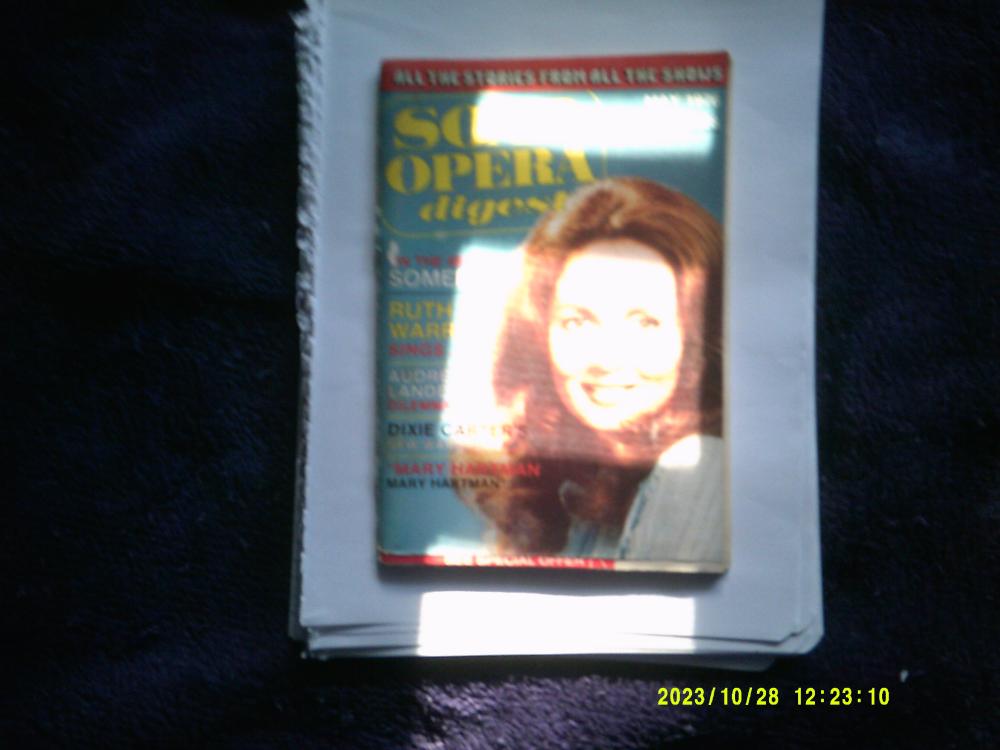
@kalbir So you think the soap press stopped being relevant as of 1998. I just think that is way too early for that indictment. Now I preferred the Atlanta mag that I think was called Soap Opera Now. It was put out by Michael Kape & Don West & Joanna maybe Koontz & they were the only mag that actually explained & interpreted ratings. And, I preferred Soap Opera Weekly because Mimi Torchin actually did Lit Crit type of criticism of the soaps. But that left a lot to be liked in SOD. The whole business suffered because they were so in bed with the shows. The whole business suffered because fans were pirates. The whole business suffered because they were slow to get on board with the Internet. But I think in general that fans learned how to be fans from the soap press & to a huge degree from SOD. How to think about, how to discuss, etc. What is the oldest SOD you have? Here's mine. May 1976, a very young Suzanne Rogers on the cover, Vol. 1, No. 6, 60 cents, 112 pgs. There were 15 soaps covered in their recaps. I have the June 1999 where SOD spent the last day at AW out in Brooklyn with the show & every page is about that.
-
Not relevant as of 1993? Crazy talk. Way off there on dates. And, Stephanie Sloane was excellent at her job/s. Yes, their circulation was too low but they were the last ones standing, the last mag to put out a print edition.
-
Digest had contracts with NBC, with AOL, maybe one more place, anyway, they were like 25 year contracts & when they ran out, no entity wanted to reup.
-
This past year they did take action about piracy. They either took action on people's Twitter accounts or they sent cease & desist letters saying they were going to begin getting people's Twitter accounts suspended. Fans went nuts! I posted about it being stealing & about copyrights & people were amazed. It was something they needed to have done long before then. This is sad to me. They were the last one still putting out a print edition. When I lived in Brooklyn from 1998-2005 I was in the Digest offices often & had friends there. They will put out 4 special issues per year & they will probably have even more content on the website. I have great memories. I was at many Digest parties after hours.
-
That was what I said when someone replied that they were of the opinion that it was punitive. And, specifically in their opinion she decided to leave & then they wrote this crap for her to have to play as she approached her exit. Given all we know about the Alarr Monster I can certainly imagine him taking out on someone via script. There was an incident where an extra bedsheet was supposed to be in place to add some "cover" for the actress & it was missing & some people think that was a Camila/Remington sex scene. Like I said I pretty much consider all theories! I really wish someone would write this as a tell-all! We would not know if there had been consequences.
-
That's what I was gonna say! Also I told a former Editor just last weekend that the newstand price is $8 & she freaked. Still going to do 4 issues a year, specials.